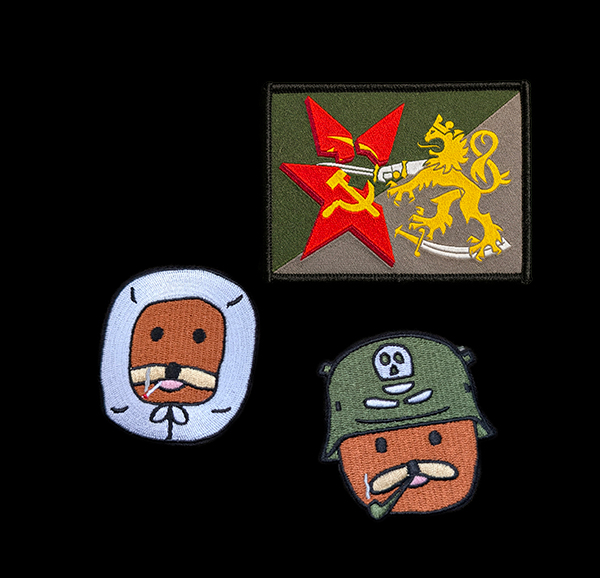
This is a 2" wide velcro backed patch.
In June 1941, with the start of the German invasion of the Soviet Union, the Finnish Defence Forces launched their offensive following Soviet airstrikes. By September 1941, Finland occupied East Karelia and reversed its post-Winter War concessions to the Soviet Union along the Karelian Isthmus and in Ladoga Karelia. The Finnish Army halted its offensive past the old border, around 30–32 km (19–20 mi) from the centre of Leningrad and participated in besieging the city by cutting its northern supply routes and digging in until 1944.[Note 8] In Lapland, joint German–Finnish forces failed to capture Murmansk or cut the Kirov (Murmansk) Railway, a transit route for lend-lease equipment to the USSR. The conflict stabilised with only minor skirmishes until the tide of the war turned against the Germans and the Soviet Union's strategic Vyborg–Petrozavodsk Offensive in June 1944. The attack drove the Finns from most of the territories they had gained during the war, but the Finnish Army managed to halt the offensive in August 1944.
Hostilities between Finland and the USSR ended with a ceasefire, which was called on 5 September, and formalised by the signing of the Moscow Armistice on 19 September. One of the conditions of this agreement was the expulsion, or disarming, of any German troops in Finnish territory, which led to the Lapland War between the former co-belligerents. World War II was concluded formally for Finland and the minor Axis powers with the signing of the Paris Peace Treaties in 1947. The treaties resulted in the restoration of borders per the 1940 Moscow Peace Treaty, the ceding of the municipality of Petsamo (Russian: Pechengsky raion) and the leasing of Porkkala Peninsula to the USSR. Furthermore, Finland was required to pay $300 million in war reparations to the USSR.
63,200 Finns and 23,200 Germans died or went missing during the war in addition to 158,000 and 60,400 wounded, respectively. Estimates of dead or missing Soviets range from 250,000 to 305,000 while 575,000 have been estimated to have been wounded or fallen sick.